Beyond the Curls: Head Shape, Ear Placement, and Everyday Care
Devon Rex and Cornish Rex are both curly-coated breeds from England, but they are not two names for the same breed: their curls arise from different inherited mutations. Compare the whole outline rather than curls alone. A Devon combines a modified wedge-shaped head, short muzzle, and low-set oversized ears with looser coat waves. A Cornish has an egg-shaped head, high-set ears, tighter waves, and a naturally arched back. Both need gentle coat handling and warm resting places. These features offer identification clues, not proof of pedigree, and personality descriptions remain tendencies rather than promises.
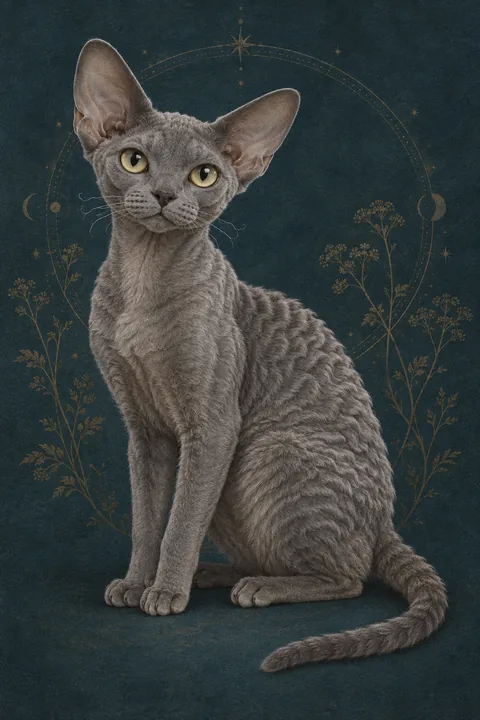
A modified wedge-shaped head, prominent cheekbones, and short muzzle accompany very large, broad-based, low-set ears: more specific clues than curls alone.
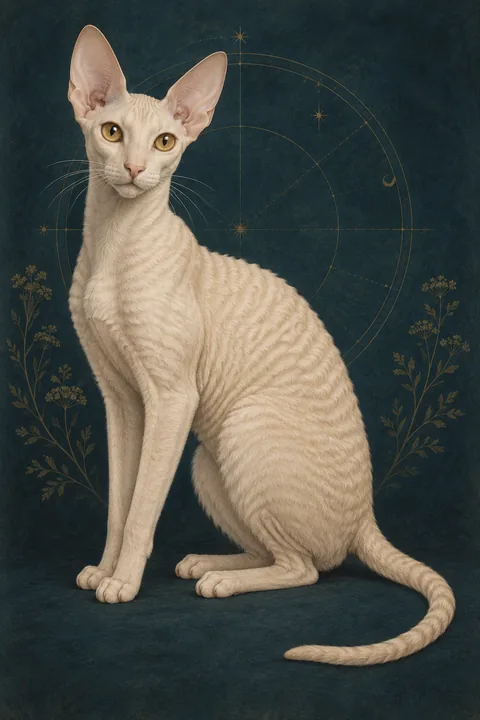
A small, egg-shaped head has prominent cheekbones, a raised Roman nose, and large, high-set ears, contrasting with the Devon's low ear placement.
Eyes
Large oval eyes are set widely apart. Read them alongside the low-set ears and short muzzle rather than using eye shape alone.
Oval eyes tilt slightly upward. The egg-shaped head and high-set ears provide additional identification clues; eye shape does not establish pedigree.
Coat texture
Soft short fur generally forms looser waves and retains sparse, short, curled guard hairs. Eyebrows and whiskers may also curl and break.
Soft short fur lies close to the body in tight waves and lacks coarse guard hairs, contrasting with the Devon's generally looser waves.
Body structure
Small to medium and lithe but muscular, with a broad chest and long slender legs; the hind legs are slightly longer than the front legs.
A slender torso and fine-boned build combine with a naturally arched back, long fine legs, and a long tapering tail for a distinctive outline.
Interaction
Many are curious, active, and people-oriented, following household activities. Tolerance for handling and strangers varies; interactive toys and dependable companionship may suit them.
Often active, curious, and involved in household life; many remain playful as adults. Compatibility with children or other pets depends on the individual and careful introductions.
Grooming routine
Use gentle hand smoothing or a soft damp cloth; avoid vigorous brushing. Provide warmth, daily interactive play, and routine veterinary care; seek advice for skin irritation or coat changes.
Handle curls gently; bathe only when needed for greasiness and towel dry. Follow veterinary ear-care advice, provide warmth, daily play, and routine care, and limit direct sun exposure.
Choosing for your everyday life
Choose by the care routine you can provide, not just the curl pattern. For a Devon, plan on gentle hand smoothing or a soft damp cloth, without vigorous brushing or attempts to straighten fragile whiskers. For a Cornish, handle curls gently, bathe only when needed for greasiness, and towel dry; also check ears, follow veterinary cleaning advice, and limit prolonged direct sun. Both need warm resting places, daily play, and routine veterinary care. Their shared active, people-oriented tendencies do not reliably identify a quieter or more cuddly option. Meet the individual cat and respect its boundaries rather than choosing from breed labels alone.
Breed descriptions are generalizations; personality, size and health needs vary. Consult a veterinarian about health concerns.
Common questions before choosing a cat
How can I tell Devon and Cornish Rex cats apart in photographs?
Start with head shape and ear placement, then compare coat and body outline. A Devon typically shows a modified wedge, short muzzle, low-set oversized ears, and looser waves. A Cornish shows an egg-shaped head, high-set ears, close tight waves, and an arched back. Color is not decisive: both have varied colors and patterns. Photographs provide clues, not confirmation of breed or pedigree; reliable records are still needed.
Do both rex breeds need frequent brushing and bathing?
Do not brush forcefully just because the coat is curly: both need gentle handling. For a Devon, use hand smoothing or a soft damp cloth and do not try to straighten whiskers. A Cornish generally does not need frequent combing; base baths on actual greasiness and veterinary advice, then towel dry, rather than imposing a fixed schedule. Both need warm resting places; Cornish care also includes ears and avoiding prolonged direct sun.
Are they the same breed, and do curls mean they never shed?
They are distinct breeds whose curls arise from different inherited mutations. Devons generally retain sparse, short, curled guard hairs, while Cornish coats lack coarse guard hairs. Both shed, even if shedding is often relatively light; neither is shedding-free. Visible hair also does not determine allergic reactions, so these coats do not promise freedom from symptoms. If allergies are a concern, seek medical advice and consider your response to the individual cat.
Sources and production notes
Text is based on the association sources below. AI-assisted original illustrations depict one coat variety, not every individual. Health and care information is general and does not replace veterinary assessment.
Based on the association sources listed on each profile. Illustrations do not establish pedigree. Independently produced by miaomap, without association endorsement. Numbers are catalog IDs, not rarity ranks.
miaomap · Updated
Meet a breed. Create your own cat.
Use our illustration creator to choose fur colors, eyes and tails, then download your own cat.