Ear shape differs; health needs more than a visual check
Scottish Folds and Scottish Straights belong to the same breed family and can even be littermates. This comparison covers their shorthaired forms, which share rounded outlines and dense, plush coats. The clearest visible difference is whether the ears fold forward and down or stand upright. That distinction also matters for welfare: the folded-ear gene is associated with osteochondrodysplasia, potentially affecting joint comfort and mobility. Upright ears neither guarantee overall health nor establish Fold-associated disease through shared ancestry. Appearance alone cannot confirm pedigree.
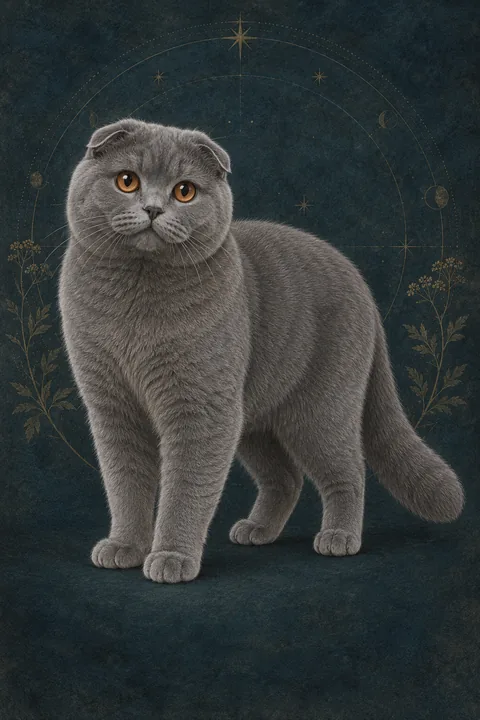
Small ears fold forward and downward above a rounded head, full whisker pads and large round eyes. Ear shape is distinctive, but cannot establish pedigree.
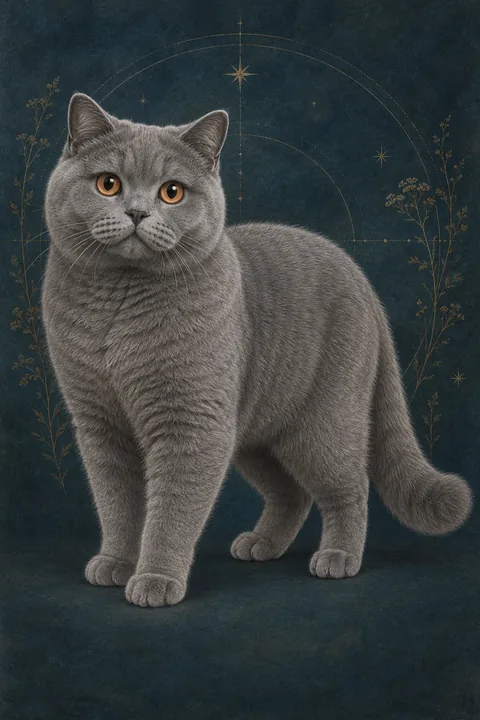
Upright ears accompany a rounded head and full cheeks. The illustrated individual has round copper eyes; those example features do not confirm pedigree.
Coat texture
The shorthaired form compared here has a dense, plush coat that does not lie flat. Many colors and patterns occur; longhaired forms also exist.
The short coat is dense, plush and stands away from the body. The pictured solid blue-gray is only an example; other colors, patterns and longhaired forms occur.
Body structure
Medium-sized, rounded and muscular, with proportionate legs rather than a short-legged build. The medium-to-long, tapering tail should move freely.
Medium-sized, rounded and balanced, with firm muscles and rounded paws. Legs have normal proportions, and the full tail should move freely; overall contours resemble the Fold.
Interaction
Often described as affectionate, easygoing and interested in interactive play, with substantial individual variation. Reduced activity, especially alongside stiffness, should not be dismissed as calm temperament.
Often described as affectionate, inquisitive and intelligent; many prefer being nearby rather than carried. Offer puzzle toys and respect individual choices about contact and retreat.
Grooming routine
Comb weekly, more during shedding, and inspect ears gently. Maintain suitable weight, provide easily reached resting places and litter trays, and never forcibly bend the tail.
Comb weekly and increase sessions during shedding. Provide interactive play, fresh water and complete balanced cat food; discuss portions with a veterinarian.
Health and welfare
The folded-ear gene is associated with osteochondrodysplasia, potentially affecting joint comfort and mobility. Arrange regular veterinary reviews; limping, stiffness or reluctance to jump needs assessment.
Discuss hypertrophic cardiomyopathy and polycystic kidney disease screening. Upright ears do not guarantee health; shared ancestry does not diagnose Fold-associated disease. Movement changes warrant assessment.
Choosing for your everyday life
Base your choice on the individual cat's health records, movement and contact preferences, not ear shape alone. Caring for a Fold calls for regular veterinary reviews, suitable weight management and easily reached resting places and litter trays; folded ears should not be treated as a purely cosmetic attraction. For a Straight, discuss heart and kidney screening with a veterinarian and review family health records. Both shorthaired forms need weekly combing, increased during shedding. Temperament descriptions are tendencies: many Straights prefer company without being carried. In either cat, limping, stiffness or reluctance to jump warrants veterinary assessment.
Breed descriptions are generalizations; personality, size and health needs vary. Consult a veterinarian about health concerns.
Common questions before choosing a cat
Can ears and coat color distinguish these cats and confirm pedigree?
Ear shape is the clearest visible distinction: Folds have ears bent forward and down, while Straights have upright ears. Both share rounded structural features and occur in shorthaired and longhaired forms. The solid blue-gray Straight in the supplied profile is an example, not the full range of colors; both have varied colors and patterns. Neither ears, coat length nor color alone confirms pedigree.
If both are shorthaired, how should their care plans differ?
Both need weekly combing, with extra sessions during shedding. For a Fold, also plan regular veterinary reviews, suitable weight management and easily reached resting places and litter trays; never forcibly bend the tail. For a Straight, discuss hypertrophic cardiomyopathy and polycystic kidney disease screening and review family health records. In either cat, limping, stiffness or reluctance to jump should not be treated simply as temperament.
Do upright ears or Fold-to-Straight mating guarantee health?
No. Upright ears do not guarantee overall health, and belonging to the Scottish family does not itself diagnose Fold-associated disease. The folded-ear gene is linked to osteochondrodysplasia, with varying severity; mating a Fold to a Straight does not guarantee unaffected offspring. Normal appearance or one normal examination cannot promise lifelong health. Limping, tail stiffness or reduced activity should be assessed by a veterinarian.
Sources and production notes
Text is based on the association sources below. AI-assisted original illustrations depict one coat variety, not every individual. Health and care information is general and does not replace veterinary assessment.
Based on the association sources listed on each profile. Illustrations do not establish pedigree. Independently produced by miaomap, without association endorsement. Numbers are catalog IDs, not rarity ranks.
miaomap · Updated
Meet a breed. Create your own cat.
Use our illustration creator to choose fur colors, eyes and tails, then download your own cat.