Modern Siamese and Traditional Thai: Compare Shape, Not Just Points
Siamese and Thai cats share roots in Thailand’s pointed cats, so blue eyes and dark extremities are not the main distinction. Here, Siamese refers to the modern CFA type: a long wedge-shaped head, large ears and elongated body, legs and tail. The Thai preserves a more moderate traditional form, with rounded cheeks, proportionate ears and a lithe, muscular body that is not tubular. Both have short coats needing gentle care and benefit from daily interaction. Appearance helps compare types, but cannot establish pedigree or predict an individual cat’s personality.
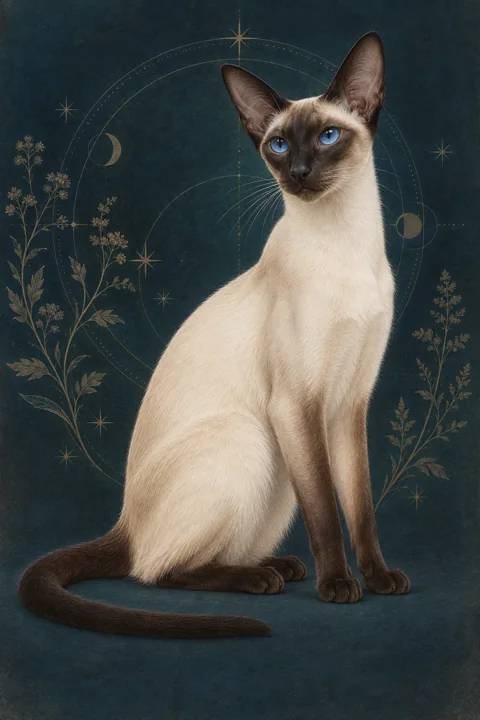
A long wedge-shaped head and large, broad-based ears give the modern type its distinctly elongated head outline.
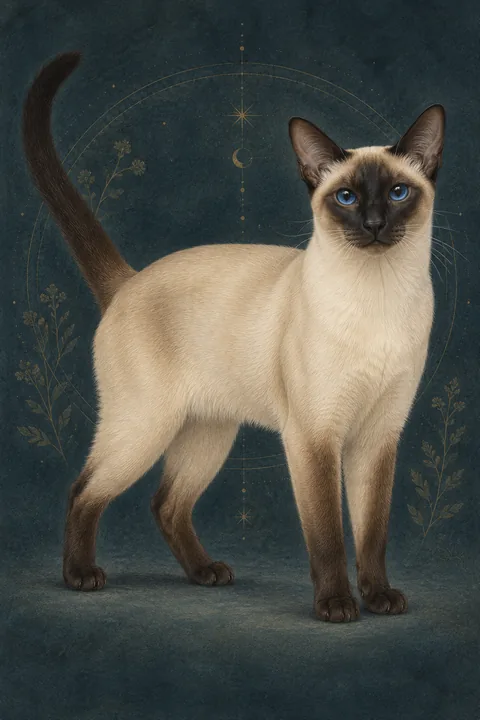
A moderate modified wedge has rounded cheeks and a tapering muzzle with a rounded end; ears are medium to slightly large and broad-based.
Eyes
Blue almond-shaped eyes are an identifying feature, but eye color alone does not distinguish Siamese from Thai or establish pedigree.
Blue eyes have a fuller almond shape; assess them alongside the softer head contours rather than treating blue eyes as a unique identifier.
Coat texture
Short, fine, close-lying fur has darker facial, ear, foot and tail points. Seal point is an example, not the only color.
Silky short fur lies close to the body with little undercoat and darker points; permitted point colors extend beyond seal and vary by association.
Body structure
Slender and muscular, with a long body, legs and tail. These elongated proportions are a central visual distinction of the modern type.
Medium-boned, lithe and muscular rather than tubular, with medium-length legs and a long tapering tail; the overall proportions remain moderate.
Interaction
Often keen on close companionship and communication through voice and body language; vocal volume and frequency vary between individual cats.
Often affectionate, intelligent and interested in household routines; some enjoy vocal communication or reward-based training, but sociability and energy vary individually.
Grooming routine
Remove loose hair regularly and gently with damp hands or a suitable rubber brush; provide daily companionship, interactive play and an enriching environment.
Brush gently weekly, adding sessions during shedding as needed. Provide daily interaction and secure climbing spaces, manage portions, and arrange dental care and routine veterinary checks.
Choosing for your everyday life
For appearance, start with the head and limb proportions: modern Siamese have a sharper wedge and longer overall lines, while Thai cats have softer contours and medium-length legs. For a practical choice, learn how the individual cat seeks interaction rather than assuming the Thai will be quieter. Siamese are often communicative, and some Thais also express needs vocally. Plan daily play, companionship and opportunities to explore. For grooming, Siamese need regular, gentle loose-hair removal; Thais usually need weekly gentle brushing, increased during shedding when necessary. Neither a short coat nor a traditional body type means care is unnecessary or health is guaranteed.
Breed descriptions are generalizations; personality, size and health needs vary. Consult a veterinarian about health concerns.
Common questions before choosing a cat
How can I distinguish modern Siamese and Thai cats in photographs?
Compare the head, ears and body proportions together, not just blue eyes and points. Modern Siamese typically show a long wedge-shaped head, large ears and elongated legs. Thai cats have a softer modified wedge, rounded cheeks, medium to slightly large ears and medium-length legs. These features help compare appearance types only; a photograph cannot confirm that a cat has a particular pedigree.
Should I choose a Thai for a quieter cat with easier grooming?
Not on breed alone. Siamese are often vocal, but some Thais also communicate readily, and neither label guarantees quietness. Both have manageable short-coat routines: regular gentle loose-hair removal for Siamese, and usually weekly gentle brushing for Thai, with extra sessions during shedding if needed. Learn the individual cat’s interaction habits and assess whether you can provide dependable daily companionship and play.
Is the Thai simply a round-faced Siamese with entirely different ancestry?
No. Both share roots in Thailand’s pointed cats. As modern Siamese proportions became more extreme, breeders preserved a moderate older type and later imported native Thai cats to support the Thai’s preservation. “Round-faced” is also incomplete: the Thai still has a modified-wedge head, with rounded cheeks and softer contours. The precise connection between the historical Wichien-maat and today’s breed remains uncertain.
Sources and production notes
Text is based on the association sources below. AI-assisted original illustrations depict one coat variety, not every individual. Health and care information is general and does not replace veterinary assessment.
Based on the association sources listed on each profile. Illustrations do not establish pedigree. Independently produced by miaomap, without association endorsement. Numbers are catalog IDs, not rarity ranks.
miaomap · Updated
Meet a breed. Create your own cat.
Use our illustration creator to choose fur colors, eyes and tails, then download your own cat.