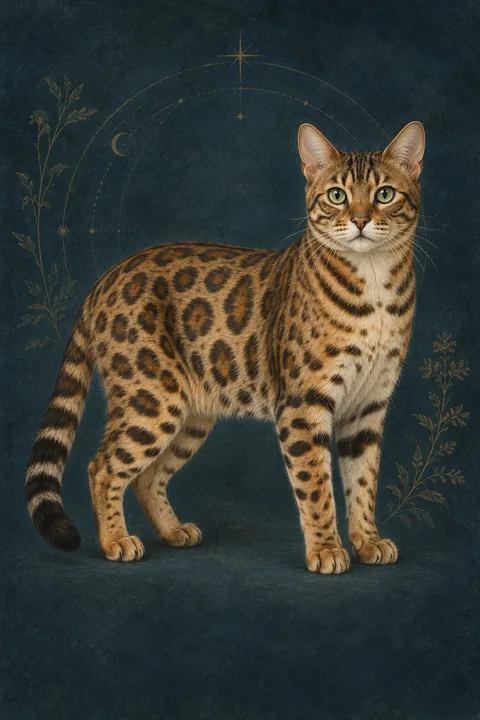
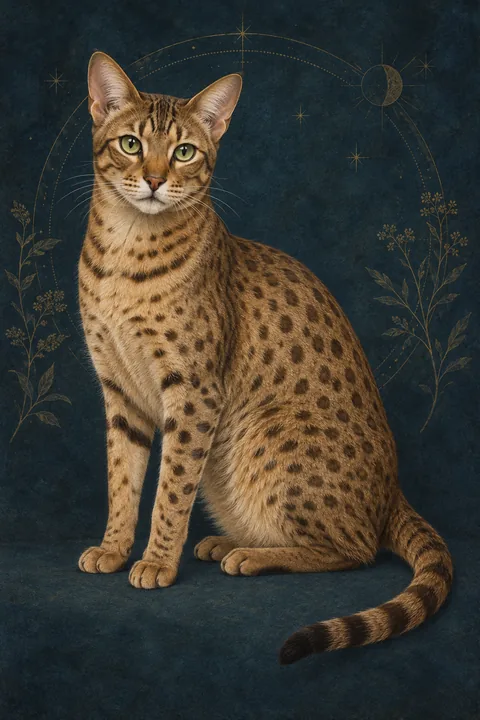
Similar wild-looking coats, different patterns and ancestry
Bengals and Ocicats both developed in the United States and have medium-to-large, muscular bodies, but their wild-looking appearance comes from different breeding histories. Bengals have Asian leopard cat ancestry and may show rosettes or marbling; Ocicats have entirely domestic ancestry and distinctive thumbprint-like spots. Beyond the coat, compare the Bengal’s rounder eyes and thick tail with the Ocicat’s almond eyes and longer, tapering tail. These are visual clues, not proof of pedigree. Practical selection also involves daily activity, health records, and, for Bengals, checking applicable local restrictions.
A rounded, broad wedge-shaped head has a wide nose and prominent whisker pads; small-to-medium ears have broad bases and rounded tips.
A modified wedge-shaped head has a broad, defined muzzle and firm chin; moderately large ears sit at the upper sides of the head.
Eyes
Large, broadly rounded eyes are set wide apart, offering a visual contrast with the Ocicat’s slightly upward-angled almond eyes.
Large almond-shaped eyes angle slightly upward. Green is not required, and eye color is not determined by coat color.
Coat texture
The close, silky short coat may show rosettes with darker outlines and lighter centers, or marbling formed by broad, irregular flowing bands.
The close-lying short coat carries distinct thumbprint-like spots and a forehead M. Different coat colors are varieties within the breed, not separate lineages.
Body structure
Medium to large and long-bodied, with muscular build, slightly raised hindquarters and somewhat longer rear legs; the medium-length tail is thick and round-tipped.
Medium to large, muscular and agile, with a fairly long body and medium-long legs; the long tail gently tapers to a dark tip.
Interaction
Often curious, athletic and interested in household activity. Some enjoy water or simple training, but sociability and vocal habits vary between individuals.
Often active, curious and sociable, with many enjoying interactive games and reward-based training; affection and responses to strangers still vary individually.
Grooming routine
Brush weekly with a soft brush; routine bathing is usually unnecessary. Provide sturdy climbing spaces, food puzzles and daily play, and check local breed and generation restrictions.
Gently groom weekly with a soft or rubber brush; frequent bathing is generally unnecessary. Provide daily interactive play, climbing opportunities and weight management.
Health and welfare
Discuss hypertrophic cardiomyopathy screening with a veterinarian; assessment may require echocardiography rather than genetic testing alone. A single result is not a lifetime health guarantee.
Ask about family histories of hypertrophic cardiomyopathy, amyloidosis and progressive retinal atrophy; discuss examinations with a veterinarian. These concerns do not mean every Ocicat develops disease.
Choosing for your everyday life
Do not choose solely for a leopard-like coat. For a Bengal, first verify local rules covering the breed and hybrid generation, then plan sturdy climbing spaces, food puzzles and daily interactive play. For an Ocicat, treat sociability as a tendency: consider the individual’s response to company, games and reward-based training. Both need gentle weekly grooming, with routine or frequent bathing generally unnecessary. Health discussions differ: ask whether a Bengal’s cardiac assessment needs echocardiography; for an Ocicat, request family records concerning heart disease, amyloidosis and retinal disease. Different lists of concerns do not establish which breed is healthier.
Breed descriptions are generalizations; personality, size and health needs vary. Consult a veterinarian about health concerns.
Common questions before choosing a cat
How can I distinguish Bengal rosettes from Ocicat spots?
Bengal rosettes usually have dark outlines around lighter centers, with markings tending to flow horizontally; Bengals can also have broad, irregular marbling. Ocicats show distinct thumbprint-like spots and a forehead M. Check other clues together: Bengals have rounder eyes and thick tails, while Ocicats have almond eyes and longer, tapering tails. These features help compare appearances but cannot confirm pedigree from a photograph.
What care and screening preparations differ before bringing one home?
Both need gentle weekly grooming, daily interactive play and climbing opportunities. For Bengals, add food puzzles and check local breed and generation restrictions before adoption, purchase or relocation. Discuss whether Bengal hypertrophic cardiomyopathy assessment requires echocardiography. For Ocicats, ask about family records of hypertrophic cardiomyopathy, amyloidosis and progressive retinal atrophy, then discuss suitable examinations with a veterinarian. Ocicat care also explicitly includes weight management.
Do both have wild ancestry, and can markings or colors reveal it?
No. The Bengal is a domestic breed with Asian leopard cat ancestry, not the wild species itself. The Ocicat developed from Abyssinians, Siamese and American Shorthairs, without ocelot ancestry. Bengal rosettes and marbling do not indicate separate ancestry, and Ocicat colors are not separate lineages. A wild-looking coat cannot establish ancestry, a Bengal’s hybrid generation or legal eligibility; documentation and applicable rules must be checked.
Sources and production notes
Text is based on the association sources below. AI-assisted original illustrations depict one coat variety, not every individual. Health and care information is general and does not replace veterinary assessment.
Based on the association sources listed on each profile. Illustrations do not establish pedigree. Independently produced by miaomap, without association endorsement. Numbers are catalog IDs, not rarity ranks.
miaomap · Updated
Meet a breed. Create your own cat.
Use our illustration creator to choose fur colors, eyes and tails, then download your own cat.