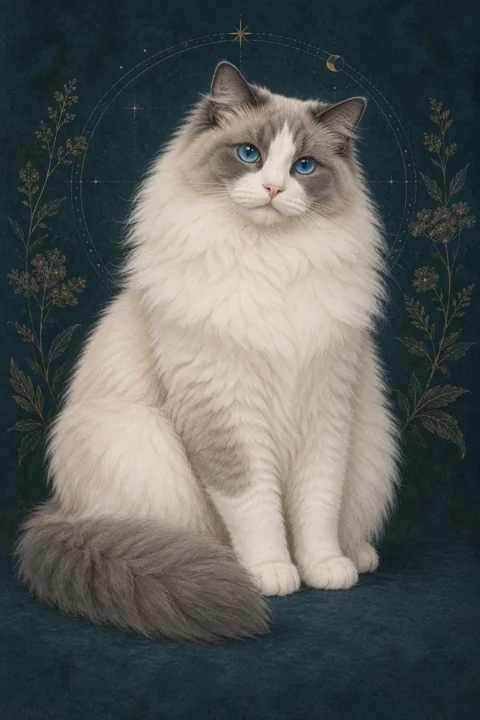
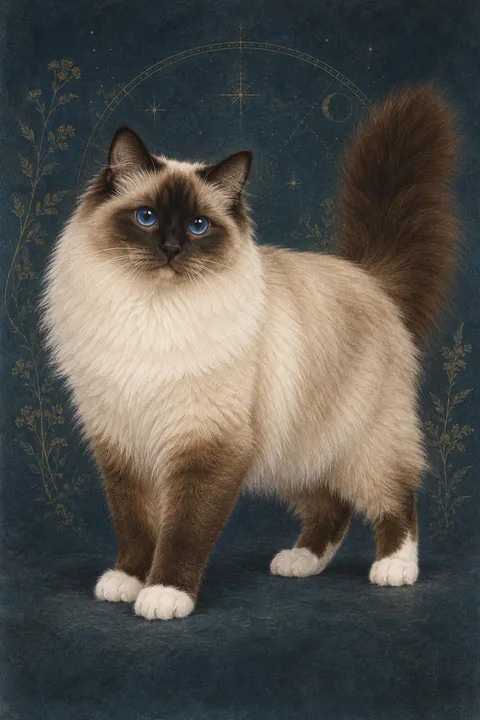
Both have blue eyes and points: compare shape, build and white markings
Ragdolls and Birmans share blue eyes, pointed coloring and silky longer coats, so those features alone do little to separate them. More useful clues are the Ragdoll’s large frame, broad chest and modified wedge-shaped head versus the Birman’s medium-to-large, elongated body and broad, rounded head. Look closely at white markings: Birmans have four gloves and pointed white laces behind the hind paws, while mitted Ragdolls typically also have a white chin and belly area. A bicolor Ragdoll may show an inverted white V on the face. These are comparison clues, not proof of pedigree; example patterns do not cover every accepted variation.
A modified wedge-shaped head provides a useful contrast with the Birman’s broad, rounded head, but head shape alone cannot establish pedigree.
The head is broad and rounded, with a firm chin, medium-length gently convex nose and medium-sized ears with rounded tips.
Eyes
The CFA standard used here calls for vivid blue eyes, a shared feature with Birmans rather than a reliable distinction or pedigree proof.
Blue eyes are nearly round and widely spaced. Consider their appearance alongside head shape, body type and white markings rather than in isolation.
Coat texture
Silky semi-long fur has darker points. Mitted cats typically have a white chin and belly area; the bicolor example shows an inverted white facial V. Other accepted patterns exist.
Silky medium-long to long fur carries darker points and four white gloves, with pointed white laces extending upward behind the hind paws.
Body structure
A large, substantial frame and broad chest are useful comparison features; assess them with head shape rather than relying only on eyes or paw markings.
Medium to large, with an elongated, sturdy body, substantial legs and a medium-length plumed tail; compare these features alongside gloves and head shape.
Interaction
Generally gentle, sociable and affectionate, with a playful side. Enjoying being held is not guaranteed; observe body language and introduce other pets gradually.
Often affectionate, gentle and moderately active, enjoying company and relaxed play. Comfort with children or pets depends on socialization, introductions and individual preferences.
Grooming routine
Comb at least once or twice weekly, adjusting to coat condition and checking armpits and belly. Provide daily interactive play, appropriate portions and veterinary checkups.
Start with weekly combing, increasing during shedding and checking underarms and hindquarters. Provide daily play and companionship, plus nail trimming and dental care.
Health and welfare
Ask about health records and relevant genetic screening, and arrange veterinary checkups. A gentle breed reputation does not guarantee effortless care or individual health.
The source notes breeder screening for hypertrophic cardiomyopathy and other conditions. Request records and discuss individual screening with a veterinarian; this is not a risk ranking.
Choosing for your everyday life
Choose by turning appearance preferences into a care plan. For a Ragdoll, plan on combing at least once or twice weekly; for a Birman, weekly combing is a starting point. Both schedules need adjustment for coat condition and shedding, with checks of tangle-prone areas. Ragdolls tend to be gentle, sociable and playful; Birmans are often described as gentle and moderately active, appreciating company and relaxed play. Neither description guarantees that an individual enjoys being held or immediately accepts other pets. Meet the cat’s preferences with gradual introductions and daily interaction. Ask for health records and discuss screening with a veterinarian; blue eyes or tidy white markings cannot establish health.
Breed descriptions are generalizations; personality, size and health needs vary. Consult a veterinarian about health concerns.
Common questions before choosing a cat
Do blue eyes, points and white gloves identify a Birman?
No. Birman clues include four white gloves and pointed white laces behind the hind paws, considered alongside a broad, rounded head and elongated, sturdy body. Mitted Ragdolls typically also have a white chin and belly area, with a modified wedge-shaped head. Both can have blue eyes and points. These features help compare appearance, but reliable registration records—not a photograph—are needed to confirm pedigree.
Which should I choose if I want less grooming work?
Breed care guidance starts Ragdolls at least once or twice weekly and Birmans at weekly combing. That does not establish that every Birman needs less work than every Ragdoll. Both shed, and seasonal shedding or individual tangling can require more frequent care. Check a Ragdoll’s armpits and belly, and a Birman’s hindquarters too. Before choosing, ask about the individual coat’s condition and your ability to maintain its care.
Does their gentle reputation guarantee cuddling or easy pet introductions?
No. Ragdolls are generally gentle, sociable and playful, but the source explicitly warns that not every individual enjoys being held. Birmans are often gentle and moderately active, appreciating companionship; comfort with children or other pets still depends on socialization and personal preferences. Both need daily interaction and gradual introductions to other pets. Choose with the individual cat’s body language and preferences in mind, rather than treating breed descriptions as promises.
Sources and production notes
Text is based on the association sources below. AI-assisted original illustrations depict one coat variety, not every individual. Health and care information is general and does not replace veterinary assessment.
Based on the association sources listed on each profile. Illustrations do not establish pedigree. Independently produced by miaomap, without association endorsement. Numbers are catalog IDs, not rarity ranks.
miaomap · Updated
Meet a breed. Create your own cat.
Use our illustration creator to choose fur colors, eyes and tails, then download your own cat.