miaomap.com · Breed atlas033 / EURBUR
European Burmese
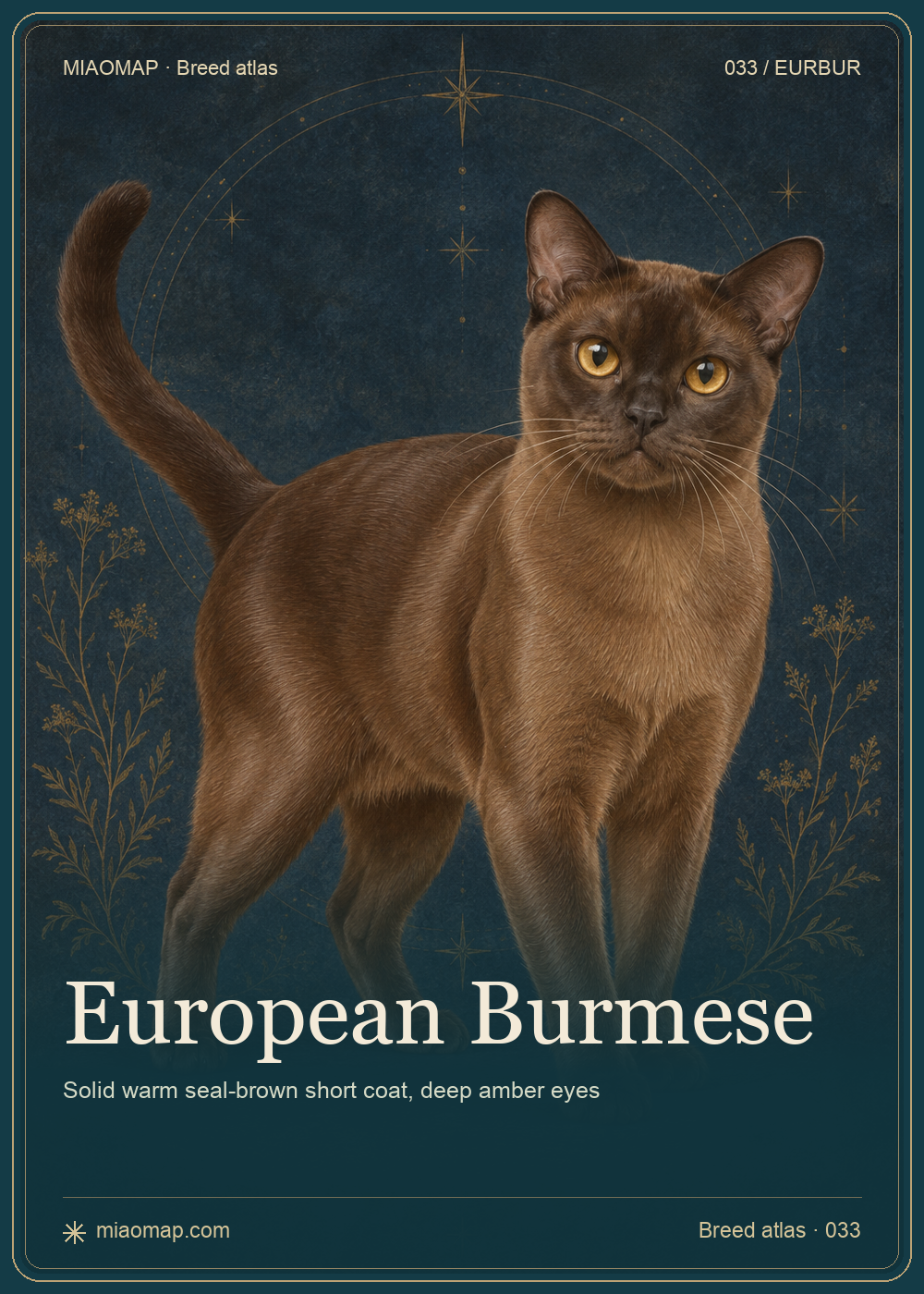
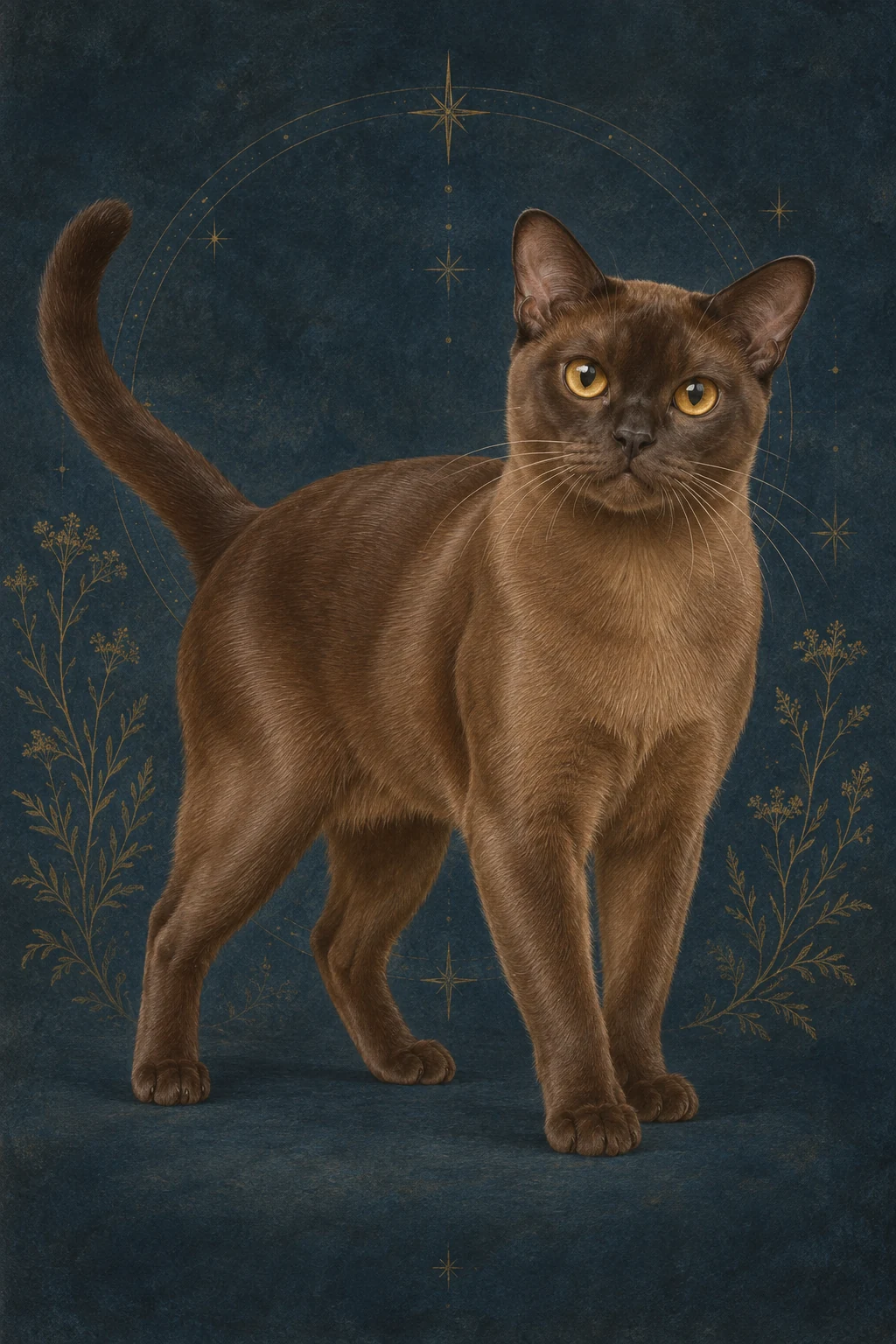
Solid warm seal-brown short coat, deep amber eyes
✳ miaomap.comBreed atlas · 033
Feline breed atlas · 033 / EURBUR
The European Burmese stands out for its satin-like short coat, distinctive amber eyes and often people-oriented nature.
Move your pointer for a subtle sheen; flip the card to read its profile.
Solid warm seal-brown short coat, deep amber eyes
European Burmese and Burmese share ancestry through Wong Mau, brought to the United States by Dr. Joseph Thompson in 1930. American-bred Burmese reached Britain from 1949, where the European Burmese developed a more moderate outline and broader color range. CFA describes ten colors; tortoiseshell coats are color varieties within the breed, not cats with separate ancestry.
A medium, muscular body rests on relatively slender legs, with slightly longer hind legs and small oval paws. The head forms a short, blunt wedge with broad cheekbones and a visible nose stop. Medium ears tilt forward. Widely spaced eyes have curved, inward-sloping upper edges, rounded lower edges and golden-to-amber color. A close short coat and medium, gently tapering tail complete the outline.
European Burmese are often described as curious, affectionate and interested in household activity. Many enjoy interactive games and close company, but not every cat will seek laps or welcome strangers. Early socialization, health and individual preferences influence behavior; offer predictable interaction, quiet resting spaces and the freedom to approach or withdraw.
Occasional gentle rubber brushing removes loose hair from this close coat; routine bathing is usually unnecessary. Provide daily interactive play, measured meals and regular veterinary visits. Ask breeders about testing and family records for inherited hypokalaemic myopathy; weakness needs veterinary assessment, not home potassium treatment. A hereditary predisposition to diabetes remains uncertain, so weight management and age-appropriate checkups remain important.
They share ancestry, but CFA describes different body types and color ranges. European Burmese have a more moderate build, a short blunt-wedge head and ten colors; Burmese are more compact and rounded, with four CFA colors. Appearance alone cannot confirm pedigree, so reliable ancestry documents matter.
Their large, widely spaced eyes are not fully round. The upper edge curves slightly and slopes toward the nose, while the lower edge is more rounded, creating the characteristic expression. CFA specifies yellow-gold to amber rather than green. Eye shape and color illustrate the standard but cannot establish breed identity.
Ask about genetic testing and family records for inherited hypokalaemic myopathy, a recessive condition for which CFA notes testing is available. Interpret results with veterinary and breeder guidance. Muscle weakness warrants examination, not self-diagnosis or potassium supplements. A genetic predisposition to diabetes has not been conclusively established.
Text is based on the association sources below. AI-assisted original illustrations depict one coat variety, not every individual. Health and care information is general and does not replace veterinary assessment.
Based on the association sources listed on each profile. Illustrations do not establish pedigree. Independently produced by miaomap, without association endorsement. Numbers are catalog IDs, not rarity ranks.
miaomap · Updated
Use our illustration creator to choose fur colors, eyes and tails, then download your own cat.