miaomap.com · Breed atlas051 / MNX
Manx
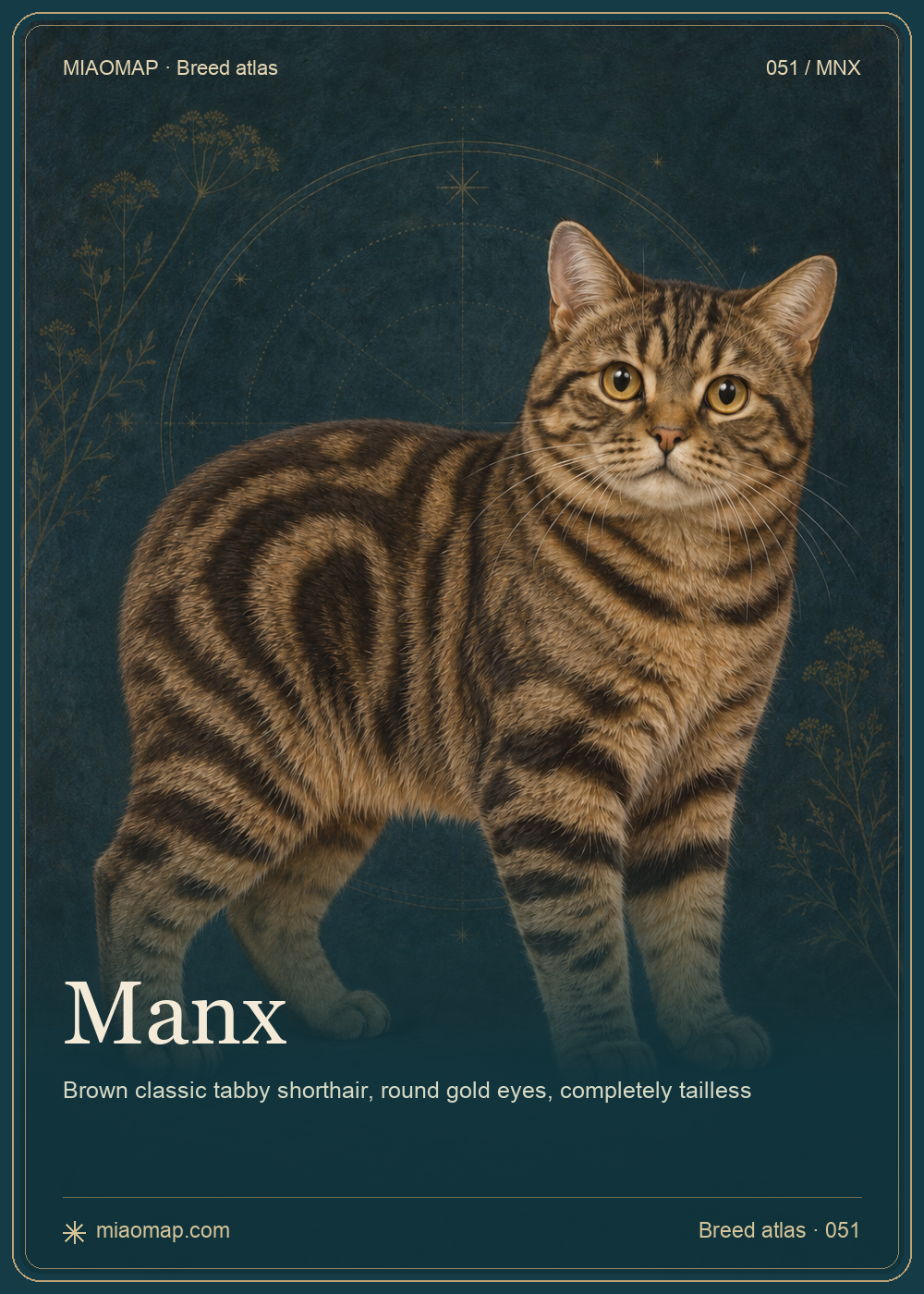
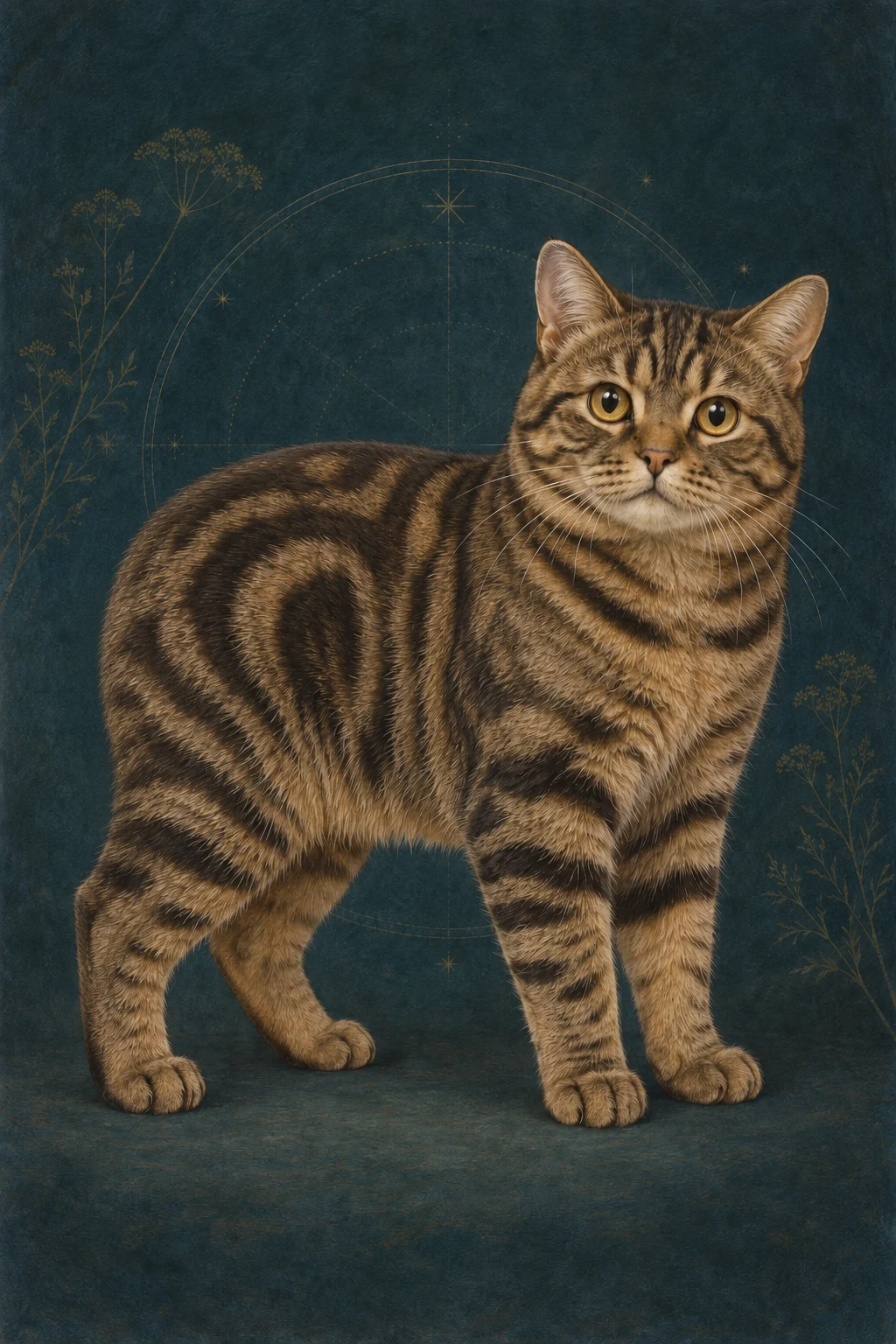
Brown classic tabby shorthair, round gold eyes, completely tailless
✳ miaomap.comBreed atlas · 051
Feline breed atlas · 051 / MNX
From the Isle of Man, the Manx is known for its rounded, sturdy body and often tailless appearance, although not every individual lacks a tail.
Move your pointer for a subtle sheen; flip the card to read its profile.
Brown classic tabby shorthair, round gold eyes, completely tailless
The Manx developed on the Isle of Man in the Irish Sea. Its tailless trait is thought to come from a natural mutation that spread through the island’s native cats, rather than the legends explaining its missing tail. Shorthaired Manx and longhaired Cymric share the same breed background; TICA groups them together, while CFA describes both coat lengths under Manx.
Look for repeated rounded contours: a full head and cheeks, broad chest, and compact, muscular body. Medium ears are widely spaced with rounded tips, and the eyes are large and round. Longer hind legs raise the rump above the shoulders, creating an arched back. The short coat is densely double-layered. Tails may be absent, partial, or full-length; appearance alone cannot establish pedigree.
Manx cats are often described as gentle and affectionate, sometimes forming especially close bonds with particular household members. Quiet lounging may alternate with chasing, interactive games, or fetching toys. Sociability and activity vary individually; introduce newcomers gradually and respect each cat’s choice to seek company or retreat.
Brush the dense short coat regularly, increasing frequency when shedding rises, and maintain healthy body condition through balanced feeding and play. Ask breeders or rescues about kitten health monitoring. Manx syndrome can involve hind-leg, bladder, and colon function, but not every tailless cat is affected. Seek veterinary advice for changes in gait or difficulty urinating or defecating rather than judging health by tail appearance.
No. Manx cats can be completely tailless, have a partial tail, or have a full-length tail. Their rounded build, substantial hindquarters, and dense coat also matter. A missing tail alone does not prove that a cat is a Manx; pedigree requires reliable records, not just a photograph.
Within TICA’s breed group, the distinction is coat length: Manx are shorthaired and Cymric are longhaired. They share a breed background rather than separate ancestry. CFA includes both coat lengths under Manx, so naming differs between associations. Both have the characteristic rounded, substantial body.
Manx syndrome refers to a group of problems that may affect hind-leg, bladder, or colon function; not every tailless cat develops them. Ask about documented kitten monitoring, veterinary assessments, and known health concerns in the family line. Changes in walking or toileting warrant veterinary evaluation, not self-diagnosis.
Text is based on the association sources below. AI-assisted original illustrations depict one coat variety, not every individual. Health and care information is general and does not replace veterinary assessment.
Based on the association sources listed on each profile. Illustrations do not establish pedigree. Independently produced by miaomap, without association endorsement. Numbers are catalog IDs, not rarity ranks.
miaomap · Updated
Use our illustration creator to choose fur colors, eyes and tails, then download your own cat.