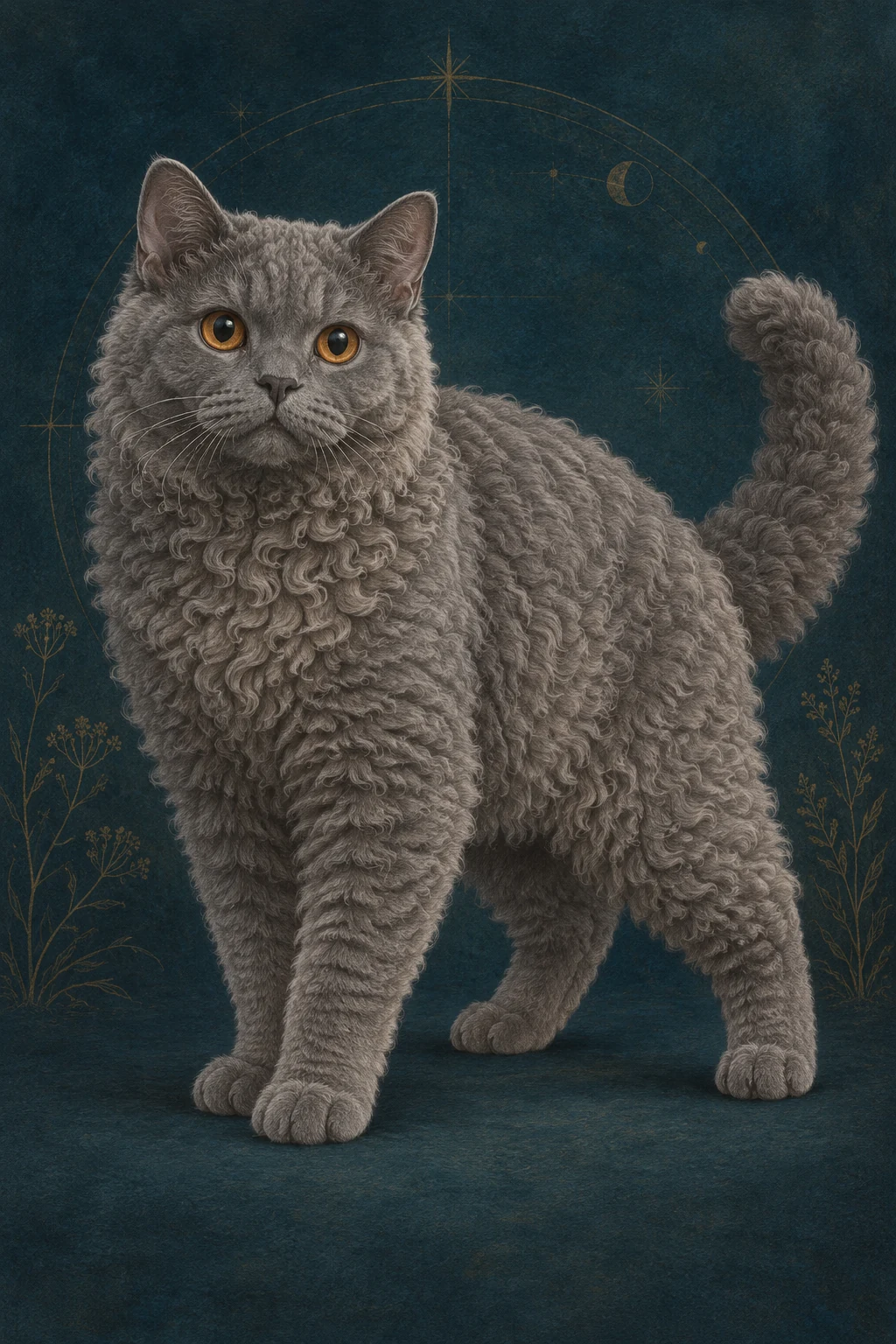
miaomap.com · Breed atlas075 / SLKR
Selkirk Rex
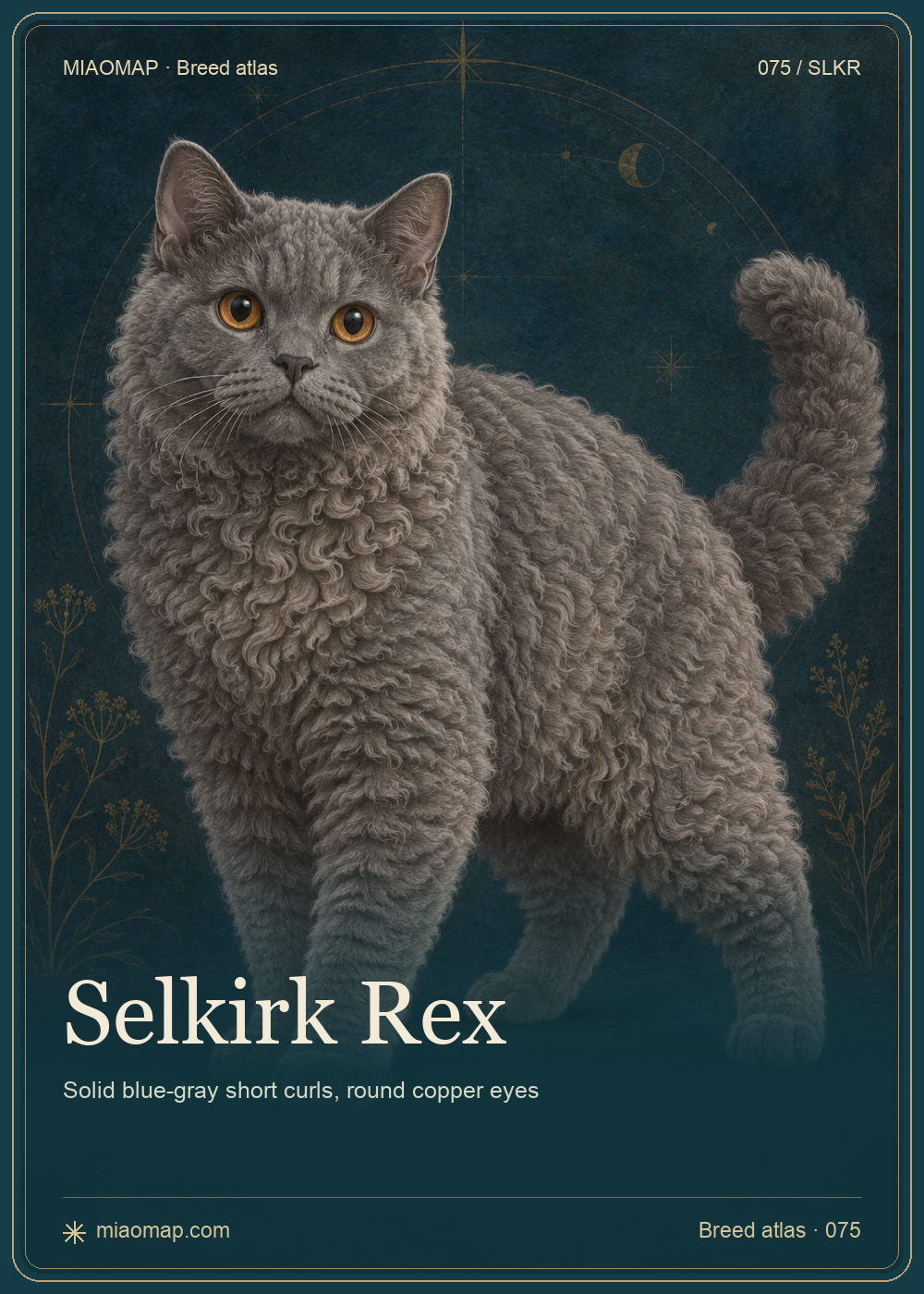
Solid blue-gray short curls, round copper eyes
✳ miaomap.comBreed atlas · 075
Feline breed atlas · 075 / SLKR
Loose curls, a rounded face and a substantial body give the Selkirk Rex its distinctive plush silhouette.
Move your pointer for a subtle sheen; flip the card to read its profile.
Solid blue-gray short curls, round copper eyes
The Selkirk Rex began with a spontaneous curly-coat mutation discovered in Montana. Persian breeder Jeri Newman adopted the curly female Miss DePesto and established that her curl trait was inherited dominantly. Newman named the breed after her stepfather’s surname. Shorthaired and longhaired Selkirks are coat variants within the same breed lineage, developed with outcrosses including Persians and British Shorthairs.
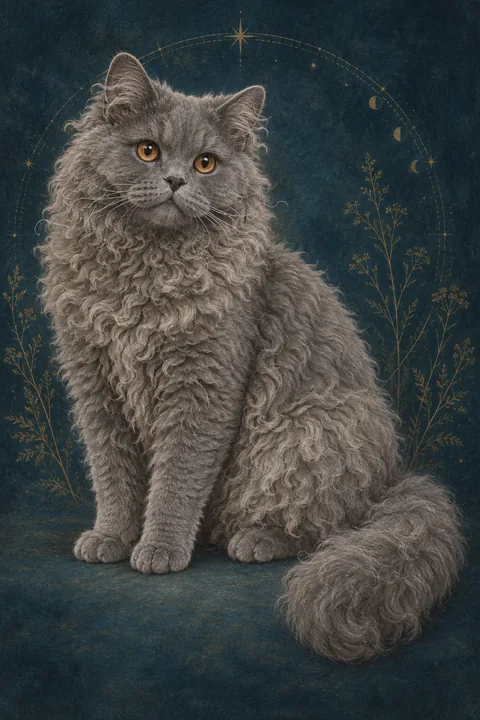
Look for dense, loose, irregular curls rather than a close-fitting wave. The broad rounded head has full cheeks, prominent whisker pads, widely spaced round eyes and medium ears. A substantial, slightly rectangular body carries sturdy legs and a medium-length tail. Shorthairs have similarly long fur on body, ruff and tail; longhairs have longer ruffs and plumy tails. Appearance cannot confirm pedigree.
Selkirks are often described as affectionate, gentle and interested in their people, without being especially vocal. Some enjoy laps, while others prefer nearby company, and they still benefit from play and exploration. Socialization, environment and individual experience shape behavior, so breed descriptions cannot guarantee any cat’s temperament.
Gently separate curls with your fingers and comb according to shedding and tangles; even the short coat can retain loose hair, while longhairs need closer mat checks. Avoid pulling fragile curly whiskers. Support a healthy weight, daily play and routine veterinary care. Ask breeders about screening for polycystic kidney disease, hypertrophic cardiomyopathy and hip dysplasia associated with some outcross breeds, not inevitable diagnoses.
The Selkirk typically has a more substantial body, rounder face and dense coat forming loose individual curls rather than close waves. Its curls arise from a distinct dominant mutation; it is not a longhaired version of either breed. Devon and Cornish Rex cats have different coat structures and builds. Curls or photographs alone cannot establish pedigree.
Yes. Kittens may be curly at birth, temporarily lose some curl and then develop their adult coat. TICA describes adult curls beginning to develop around eight to ten months, with coat development continuing until approximately two years. Season, climate and hormones also affect curl, so one observation does not predict the final coat.
Both need gentle handling and removal of loose hairs retained in the dense curls. Shorthairs have compact ruff and tail fur; longhairs have longer ruffs and plumy tails that warrant closer tangle checks. Adjust combing to the actual coat condition, separate curls gently, and never ignore mats simply to preserve their shape.
Text is based on the association sources below. AI-assisted original illustrations depict one coat variety, not every individual. Health and care information is general and does not replace veterinary assessment.
Based on the association sources listed on each profile. Illustrations do not establish pedigree. Independently produced by miaomap, without association endorsement. Numbers are catalog IDs, not rarity ranks.
miaomap · Updated
Use our illustration creator to choose fur colors, eyes and tails, then download your own cat.