Compare head shape first, then coat and care needs
Norwegian Forest Cats and Siberians share substantial bodies, semi-long coats, prominent ruffs and bushy tails. The more useful visual distinction is head shape: the Norwegian Forest Cat emphasizes a balanced triangle, straight profile and almond eyes, while the Siberian has a broad, rounded wedge, fuller muzzle and nearly round eyes. Their double and triple coats also come with different grooming details. Use these features to compare appearances, not to establish pedigree. The breed profiles do not establish either breed as hypoallergenic, so that claim should not drive selection.
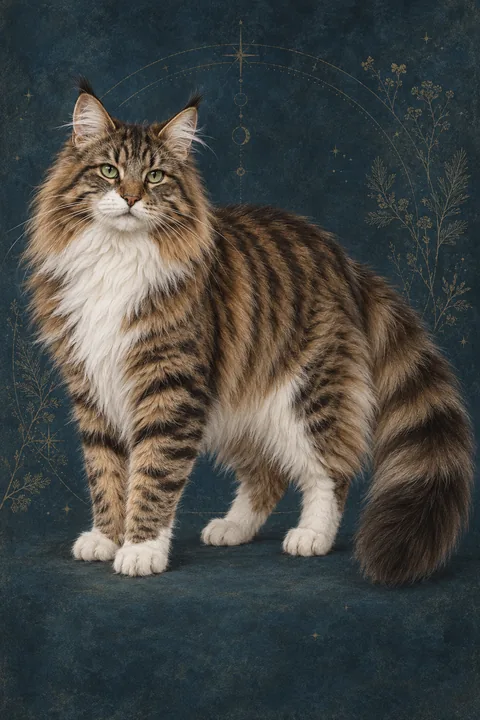
A balanced triangular head and straight brow-to-nose profile are key clues. Broad-based ears have abundant furnishings; lynx-like ear tips are possible, not essential.
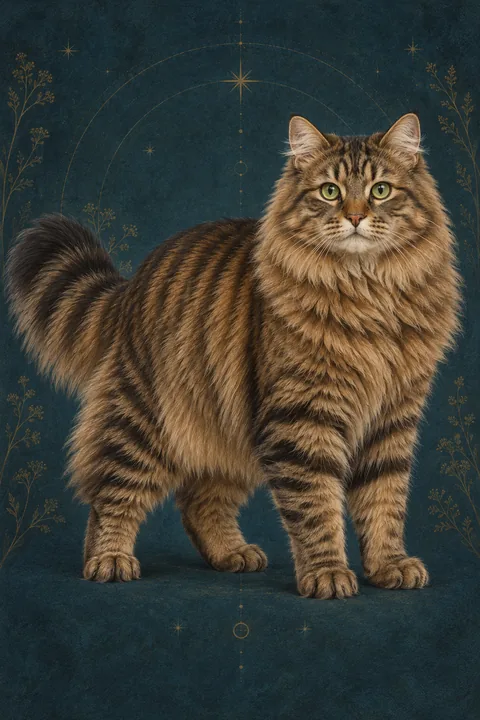
A broad, rounded wedge-shaped head and full muzzle create softer contours. Medium-large ears have broad bases, rounded tips and a slight forward tilt.
Eyes
Large almond-shaped eyes sit at a slight slant. Read them alongside the triangular head rather than using a fluffy coat as the identifying feature.
Widely spaced, nearly round eyes complement the broad, rounded head. Compare this combination with the Norwegian Forest Cat's almond eyes, not eye shape alone.
Coat texture
The semi-long double coat has dense underfur and longer, water-resistant guard hairs. A prominent ruff, full britches and long bushy tail stand out; density changes seasonally.
The dense semi-long triple coat combines soft undercoat, intermediate awn hairs and longer guard hairs. It is generally fuller in winter and may shorten and thin in summer.
Body structure
A substantial, muscular frame has hind legs longer than the front legs and large tufted paws. Slow maturation is not a reason to keep increasing food.
A medium-large, substantial and muscular body has a barrel-shaped trunk, medium-length legs and large round paws. The bushy tail is slightly shorter than the body.
Interaction
Often described as intelligent, independent and friendly, they may stay near family without wanting cuddles or laps. Socialization, age and environment shape the individual.
Often described as curious and sociable, some follow people and enjoy interactive games; others need more quiet space. Breed does not guarantee compatibility.
Grooming routine
Use a metal comb regularly, especially during spring shedding; check armpits, belly and britches. Provide stable climbing structures, play and measured meals.
Comb weekly; check belly, tail and britches several times weekly, increasing grooming during shedding. Gently separate small tangles; seek professional help for skin-adjacent mats.
Health and welfare
Hypertrophic cardiomyopathy and glycogen storage disease have been reported. Ask for relevant screening records and veterinary follow-up; screening cannot guarantee lifelong freedom from disease.
Discuss inherited concerns including hypertrophic cardiomyopathy and polycystic kidney disease, plus appropriate screening, during veterinary visits. Breed alone does not establish disease in an individual.
Choosing for your everyday life
Separate appearance preferences from the care you can provide. A Norwegian Forest Cat fits the triangular-head, straight-profile look; its tendency to stay near family need not mean enjoying being held. A Siberian fits rounded contours and a barrel-shaped body; some follow people and join games, but not every individual does. Plan regular metal-comb grooming with extra spring attention for the Norwegian Forest Cat, versus weekly combing plus several weekly tangle checks for the Siberian. Both need sturdy climbing facilities and weight management. Meet the individual cat and ask about relevant screening rather than choosing on a hypoallergenic label unsupported by these records.
Breed descriptions are generalizations; personality, size and health needs vary. Consult a veterinarian about health concerns.
Common questions before choosing a cat
How can I compare Norwegian Forest and Siberian cats in photos?
Start with the head, not coat volume. A Norwegian Forest Cat typically shows a balanced triangle, straight brow-to-nose profile and slightly slanted almond eyes. A Siberian emphasizes a broad, rounded wedge, full muzzle and widely spaced, nearly round eyes. Both can have prominent ruffs and bushy tails. These are visual clues only: mixed-breed cats may resemble either, and confirming pedigree requires reliable records.
Which coat is easier to manage, and what grooming should I plan?
The records do not support ranking one as easier. For a Norwegian Forest Cat, plan regular metal-comb grooming, extra spring attention and checks of armpits, belly and britches. For a Siberian, plan weekly combing and several weekly checks of belly, tail and britches, increasing grooming during shedding. Tight mats near skin need professional help. Base your schedule on the actual coat condition rather than the number of coat layers alone.
Is a Siberian more hypoallergenic than a Norwegian Forest Cat?
A double or triple coat cannot predict allergy reactions, and a Siberian cannot be guaranteed safe for someone with cat allergies. Both breeds shed; reactions vary between people and individual cats. Coat volume, grooming frequency and breed names do not provide a reliable allergy ranking. If you have cat allergies, seek medical advice and assess your own reactions rather than relying on a hypoallergenic label.
Sources and production notes
Text is based on the association sources below. AI-assisted original illustrations depict one coat variety, not every individual. Health and care information is general and does not replace veterinary assessment.
Based on the association sources listed on each profile. Illustrations do not establish pedigree. Independently produced by miaomap, without association endorsement. Numbers are catalog IDs, not rarity ranks.
miaomap · Updated
Meet a breed. Create your own cat.
Use our illustration creator to choose fur colors, eyes and tails, then download your own cat.